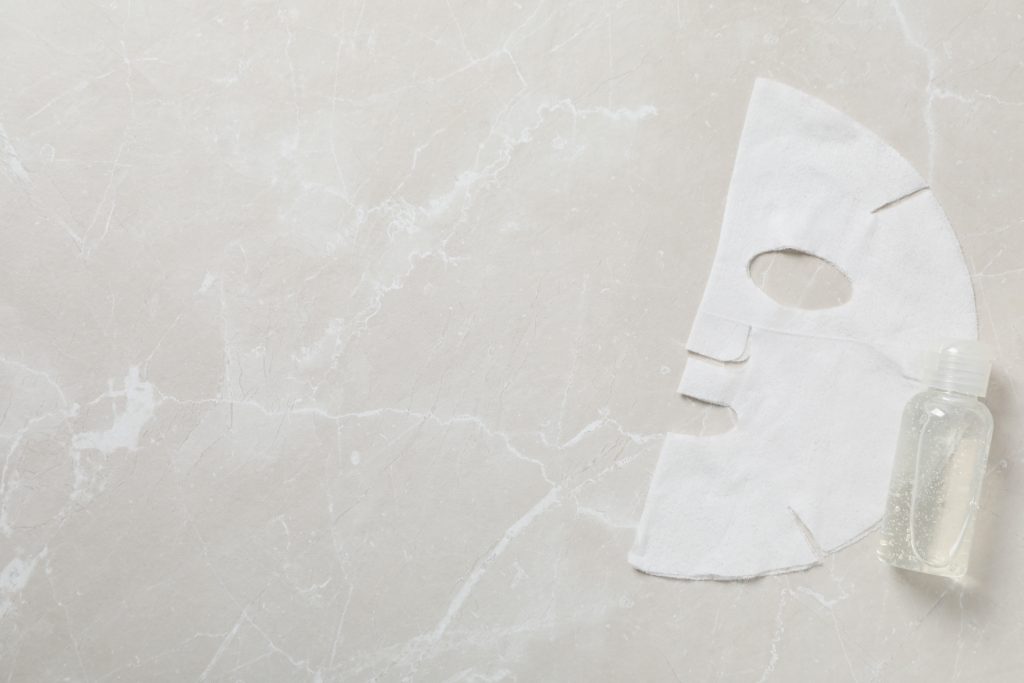
Facial mask material is the single most important variable in a sheet mask formulation. The substrate determines how much serum the mask holds, how well it conforms to the face, how long it stays moist, and ultimately how effectively active ingredients penetrate the skin. This guide explains every major type of facial mask material, how to choose the right one, and how to use it for maximum results — whether you are a brand formulator, contract manufacturer, or end consumer in Malaysia.
What Is Facial Mask Material?
Facial mask material is a thin, porous substrate cut into a face-shaped sheet, saturated with a serum or essence, and applied to the skin for 15 to 20 minutes. The material acts as a reservoir and delivery vehicle — it traps moisture against the skin, creates an occlusive layer that boosts active ingredient absorption, and prevents the serum from evaporating. According to the Cosmetics & Toiletries journal (2025) , sheet masks deliver 2 to 4 times more active ingredient into the stratum corneum compared to leave-on serums applied without occlusion.
The global sheet mask market was valued at USD 520 million in 2024 and is projected to reach USD 1.1 billion by 2030, driven by demand from South Korea, Japan, and Southeast Asia including Malaysia. The choice of facial mask material accounts for approximately 30 to 40% of a mask’s total production cost and has a direct impact on consumer perception of quality.
How Does Facial Mask Material Work?
Facial mask material works through occlusion — it seals moisture and active ingredients against the skin surface, increasing hydration levels in the outer skin layer (stratum corneum) by up to 60% within 20 minutes. This occlusive effect temporarily swells the skin cells, opening microchannels that allow water-soluble actives such as hyaluronic acid, niacinamide, and vitamin C to penetrate more effectively than under normal conditions.
The material’s fibre structure also plays a critical role. Finer fibres create a larger surface area with smaller pores, which holds more serum per square centimetre. According to a 2024 study published in the International Journal of Cosmetic Science , bio-cellulose masks retain up to 100 times their dry weight in liquid, compared to 8 to 12 times for standard non-woven polypropylene substrates. This difference translates directly into how long the mask stays wet on the face and how much active ingredient is available for absorption.
Key Benefits of Facial Mask Material
The right facial mask material delivers measurable, immediate results: increased skin hydration, improved active ingredient absorption, and a visible brightening or calming effect within a single 20-minute application.
· Immediate hydration boost — skin hydration levels increase 40 to 60% after one application, measured by corneometer readings
· Enhanced active delivery — occlusion increases transdermal penetration of hyaluronic acid by up to 4x compared to topical serum alone
· Reduced irritation — premium substrates like bio-cellulose and tencel are naturally hypoallergenic and suitable for reactive or sensitised skin
· Convenience — pre-cut, pre-saturated sheets require no mixing or application tools, making them ideal for on-the-go skincare
· Consistent dosage — each mask unit delivers a pre-measured volume of serum, ensuring reproducible results across every application
· Cooling effect — hydrogel materials provide a cooling sensation on contact that reduces visible redness within minutes
Types of Facial Mask Material Explained
There are six primary types of facial mask material, each with distinct properties, costs, and ideal use cases. Choosing the right substrate is the first and most important formulation decision for any sheet mask product.
| Material Type | Serum Retention | Skin Adhesion | Best For | Cost Level |
| Non-woven (polypropylene/rayon) | 8–12x dry weight | Moderate | Everyday masks, mass market | Low |
| Bio-cellulose | Up to 100x dry weight | Excellent — second-skin fit | Premium, sensitive skin, anti-ageing | High |
| Hydrogel | High — gel structure holds moisture | Very good | Cooling, brightening, oily skin | Medium-High |
| Silk (natural or vegan) | Medium | Good | Luxury, anti-ageing, dry skin | High |
| Tencel (Lyocell) | Medium-High | Good | Eco-conscious, sensitive skin | Medium |
| Cotton | Low-Medium | Moderate | Natural positioning, DIY masks | Low-Medium |
Non-Woven Fabric
Non-woven fabric is the most widely used facial mask material globally. It is manufactured from synthetic fibres (polypropylene, polyester) or natural fibres (rayon, viscose) bonded together through mechanical, chemical, or thermal processes — not weaving. Non-woven masks account for approximately 65% of the global sheet mask market by volume. They are cost-effective, available in a wide range of thicknesses, and compatible with most serum formulations. The main limitation is lower serum retention and less precise skin contouring compared to bio-cellulose.
Bio-Cellulose
Bio-cellulose is produced by fermenting coconut water with the bacteria Komagataeibacter xylinus , resulting in a nano-fibre network with exceptional moisture-holding capacity. A single bio-cellulose sheet holds up to 100 times its dry weight in serum. The material conforms intimately to facial contours — including around the nose and chin — with a second-skin fit that maximises surface contact and active ingredient delivery. Bio-cellulose is the material of choice for premium and clinical-grade sheet masks in Malaysia and globally.
Hydrogel
Hydrogel masks are made from a water-based polymer gel — typically polyacrylamide or carrageenan — that is cross-linked to form a solid-yet-flexible sheet. The gel structure provides an immediate cooling sensation, reduces redness visibly within 5 to 10 minutes of application, and maintains moisture for longer than non-woven substrates. Hydrogel is most effective for oily or combination skin types and for masks targeting brightening, pore minimising, or post-procedure recovery.
How to Use Facial Mask Material Step-by-Step
Using facial mask material correctly takes less than 30 minutes and requires clean skin, proper positioning, and correct removal technique to achieve optimal results.
· Cleanse your face — remove all makeup, SPF, and surface oils with a gentle cleanser. Residue on the skin surface reduces active ingredient penetration by up to 50%.
· Apply toner (optional) — a hydrating toner prepares the skin and opens microchannels for better active absorption. Apply and let absorb for 60 seconds before masking.
· Open the mask packet and unfold carefully — most sheet masks have a protective backing layer. Remove one side, place the mask on the face, then remove the remaining layer.
· Align to facial landmarks — position the eye holes over the eyes and the mouth hole over the lips. Smooth the mask from the centre outward to eliminate air pockets and maximise skin contact.
· Leave on for 15 to 20 minutes — do not exceed 25 minutes. Once the mask dries, it begins drawing moisture back out of the skin.
· Remove and massage remaining serum — after removal, pat the remaining serum into the skin. Do not rinse. The serum left on the skin continues to work for up to 2 hours.
· Follow with moisturiser — seal the hydration boost with a moisturiser or facial oil within 60 seconds of mask removal to lock in the effects.
Facial Mask Material Best Practices
Brands and manufacturers who follow these best practices produce sheet masks that consistently outperform competitors in consumer testing. Ocean Cash recommends the following guidelines based on experience supplying facial mask material to cosmetic brands across Malaysia and Southeast Asia.
· Match material to serum viscosity — low-viscosity watery serums require high-density non-woven or bio-cellulose. Thick gel serums work better with hydrogel substrates that have a naturally gel-compatible structure.
· Conduct saturation testing before production — measure the exact serum volume each substrate retains at room temperature (25°C) and after refrigeration (5°C) to calculate fill volume accurately.
· Use individually sealed foil pouches — exposure to air degrades water-soluble actives like vitamin C and retinol within 48 hours. Nitrogen-flushed foil pouches extend shelf life to 18 to 24 months.
· Test skin adhesion at 37°C — skin temperature in Malaysia’s tropical climate differs from ambient. Test mask adhesion and serum release rate at body temperature to reflect real-world conditions.
· Specify cut dimensions to ±0.5mm tolerance — facial mask material cut accuracy affects consumer fit. Standardise die-cutting specifications for each face size: S, M, L.
· Audit fibre composition with FTIR testing — verify that non-woven substrates meet claimed fibre ratios. Discrepancies in rayon/polyester ratios affect serum absorption and mask transparency.
Key Takeaways
· Facial mask material is the primary determinant of sheet mask performance — it controls serum retention, skin adhesion, and active ingredient delivery.
· Bio-cellulose holds up to 100x its dry weight in serum — 8 to 12x more than standard non-woven substrates.
· Sheet masks deliver 2 to 4x more active ingredient into the skin than leave-on serums applied without occlusion.
· Six main material types exist: non-woven, bio-cellulose, hydrogel, silk, tencel, and cotton — each suited to different price points and skin types.
· Correct application takes 15 to 20 minutes on clean skin followed immediately by moisturiser.
· For manufacturers: match substrate to serum viscosity, conduct saturation testing, and specify cut tolerances before production begins.
· Ocean Cash supplies facial mask material across Malaysia with full quality documentation and sample availability.
Frequently Asked Questions About Facial Mask Material
What is facial mask material?
Facial mask material is a thin, porous substrate — typically non-woven fabric, bio-cellulose, hydrogel, silk, or tencel — that is cut into a face shape, saturated with serum, and applied to the skin. The material acts as both a reservoir for active ingredients and an occlusive layer that increases skin absorption. It is the core component of all sheet face masks.
Which facial mask material is best for sensitive skin?
Bio-cellulose and tencel (lyocell) are the best choices for sensitive skin. Both are hypoallergenic, free from synthetic binders, and naturally breathable. Bio-cellulose — derived from fermented coconut water — has the softest texture and closest skin adhesion of any mask substrate, minimising the risk of irritation or allergic reaction.
How long should a facial mask be left on?
15 to 20 minutes is the optimal application time for most facial mask materials. Leaving a sheet mask on beyond 25 minutes risks the reverse effect — the drying material draws moisture from the skin rather than delivering it. Always check the specific instructions for each product formulation.
What is the difference between non-woven and bio-cellulose mask material?
Non-woven fabric is made from synthetic or plant-based fibres bonded without weaving — it is cost-effective and widely available. Bio-cellulose is a natural nano-fibre produced by bacterial fermentation, holding up to 100 times its dry weight in serum. Bio-cellulose offers superior adhesion, serum retention, and skin compatibility at a higher cost per unit.
Where can I source facial mask material in Malaysia?
Ocean Cash supplies a full range of facial mask material in Malaysia including non-woven, bio-cellulose, hydrogel, silk, and tencel substrates. Both wholesale and custom-cut options are available. Contact Ocean Cash for samples, pricing, and material specifications suited to your formulation.
Can facial mask material be used to make DIY face masks at home?
Yes. Plain non-woven or cotton mask sheets — available without serum — can be purchased and saturated with homemade serums or essences at home. However, for consistent results and measurable active ingredient delivery, pre-formulated professional facial mask material from a reputable supplier like Ocean Cash is recommended.