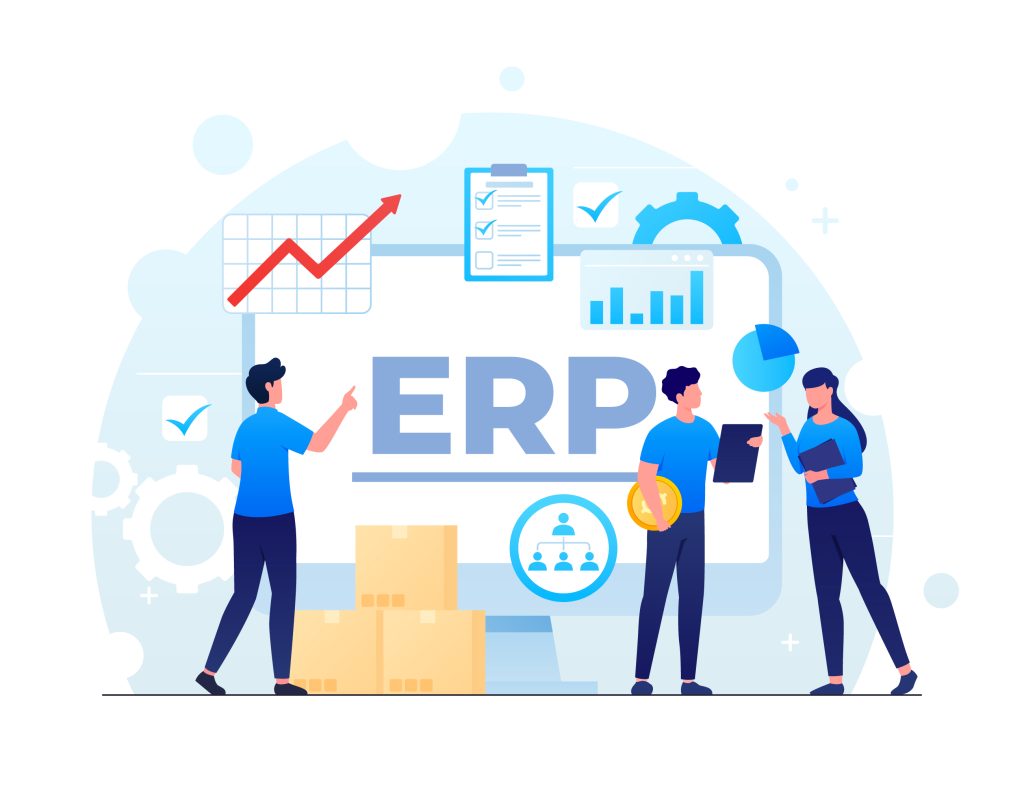
As Malaysian businesses grow beyond the scale manageable with spreadsheets and standalone accounting software, the operational costs of disconnected systems become impossible to ignore. Purchase orders created in one system require manual re-entry into the accounts payable module. Inventory counts in the warehouse do not reconcile with the quantity shown in the sales system until someone has had time to update both. Monthly financial reporting requires a multi-day reconciliation effort because data exists in incompatible formats across departments. These are not signs of operational failure — they are the predictable consequences of business growth outpacing the systems designed to support a smaller operation.
A properly selected and implemented ERP Malaysia system resolves this fragmentation by creating a single integrated platform where every business transaction — a sales quotation, a purchase receipt, a production completion, a payroll journal — updates the same central database in real time. Every function sees the same data. Finance doesn’t need to wait for logistics to send an export; the data is already there. Management reporting that previously required days of data gathering becomes available on demand.
The Core Business Case: What ERP Actually Changes
The value proposition of ERP is not automation for its own sake — it is the elimination of the friction, delay, and error that disconnected systems create. Inventory accuracy improvements are typically among the most immediately measurable outcomes of ERP implementation. When goods receipts, sales orders, production issues, and adjustments all post to the same inventory ledger in real time, physical inventory counts and system balances align. The procurement team no longer orders material that is sitting in a remote warehouse because the system didn’t know it was there.
Financial close acceleration is another near-universal benefit. With all transaction data — sales, procurement, inventory movements, payroll, fixed assets — residing in one integrated system, the month-end close process reduces from a multi-day manual effort to a process measurable in hours. Intercompany reconciliations for businesses with multiple entities become automated. Audit preparation requires pulling reports from one system rather than assembling data from many. The finance team’s time shifts from data collection and reconciliation to analysis and decision support — a transformation in the function’s strategic contribution.
Supply chain visibility — knowing where materials are, what orders are committed, what production is in progress, and what customer commitments are at risk — enables proactive management rather than reactive firefighting. ERP systems that integrate procurement, inventory, production planning, and sales order management give operations teams the real-time view needed to identify potential shortfalls before they become customer delivery failures.
Cloud ERP vs On-Premise: The Decision Framework for Malaysian Businesses
The technology delivery model — cloud subscription (SaaS) vs on-premise licensed software installed on company-owned or data-centre infrastructure — is among the first decisions in any ERP evaluation and carries implications for cost structure, IT requirements, data control, and flexibility.
Cloud ERP delivered as Software as a Service (SaaS) has fundamentally changed ERP accessibility for Malaysian SMEs. Subscription pricing replaces the large upfront licence fees that previously made enterprise software inaccessible to smaller businesses. The vendor manages infrastructure, security patching, disaster recovery, and platform updates — eliminating the need for a dedicated IT operations team to keep the system running. Implementation timelines are typically shorter because the software environment is pre-configured and available immediately. For businesses with standard processes and limited IT resources, cloud ERP is frequently the correct choice on both financial and operational grounds.
On-premise ERP retains relevance for organisations with specific requirements that cloud delivery cannot accommodate: extensive customisation requirements that exceed the flexibility of standard SaaS configurations, data sovereignty requirements that mandate local data storage under the organisation’s direct control, integration with proprietary legacy systems that cannot interface with cloud platforms, or operation in environments with insufficient or unreliable internet connectivity. The total cost of ownership comparison between cloud and on-premise over a ten-year horizon sometimes favours on-premise for large organisations with stable, well-defined processes — the subscription costs of a large cloud ERP over a decade can exceed the amortised cost of perpetual licence plus infrastructure.
Module Selection: Building the Right Scope
ERP platforms are modular, and the right implementation scope depends on the business’s processes, priorities, and change management capacity. Attempting to implement every available module simultaneously overloads the organisation’s ability to absorb change and dramatically increases implementation complexity and risk. A phased approach — implementing core financial and operational modules first, stabilising, and then extending functionality — consistently outperforms big-bang implementations in both on-time delivery and actual value realisation.
The foundational modules for most Malaysian businesses are financial accounting (general ledger, accounts receivable, accounts payable, fixed assets, financial reporting) and either inventory management or customer order management depending on whether the business is primarily distribution or service-oriented. From this foundation, manufacturing businesses add production planning and shop floor data collection; project-based businesses add project costing and resource management; businesses with complex distribution networks add warehouse management and transportation management.
Implementation Success: The Human Factors That Decide Outcomes
ERP implementation failure rates are extensively documented in both academic research and industry surveys. The consistent finding is that technical failure — the software not working as specified — is rarely the primary cause. Projects fail because of inadequate executive sponsorship, unclear business requirements, poor data quality at migration, insufficient user training, and resistance to process change. These are all human and organizational factors, and they require human and organizational solutions.
Executive sponsorship — visible, sustained, and active support from senior leadership for the ERP program — is the single strongest predictor of implementation success. When leadership communicates clearly that the new system is the future, that old ways of working will not be maintained in parallel indefinitely, and that the organization is committed to the change, user adoption accelerates and resistance diminishes. When leadership is ambivalent, the project senses it immediately, and the path-of-least-resistance becomes maintaining the old processes alongside the new system — which defeats the purpose entirely.
Data quality is the other frequently underestimated success factor. An ERP system populated with inaccurate, incomplete, or duplicated master data from the outset will produce inaccurate outputs regardless of how well the software is configured. The data migration phase — extracting data from legacy systems, cleansing it, mapping it to the ERP’s data structures, and validating it before go-live — requires sustained effort and business owner involvement that many implementations underresource until it is too late to address properly.
Frequently Asked Questions
Q: What is ERP and why does my Malaysian business need it?
A: ERP (Enterprise Resource Planning) is an integrated software platform that manages core business functions — accounting, inventory, procurement, sales, production, and HR — within a single system sharing a common database. Malaysian businesses need ERP when the inefficiency and error cost of disconnected systems begins to materially affect customer service quality, reporting accuracy, or operational scalability.
Q: How much does ERP implementation cost in Malaysia?
A: Cloud ERP subscriptions for Malaysian SMEs range from approximately RM 500 to RM 5,000 per month depending on user count and module scope. Full enterprise on-premise implementations including software licence, implementation services, hardware, and training typically range from RM 150,000 to over RM 1 million for large, complex organisations. Total cost of ownership analysis over five to ten years provides a more meaningful comparison between delivery models than upfront cost alone.
Q: How long does an ERP implementation take in Malaysia?
A: A straightforward cloud ERP implementation for an SME with standard processes may be completed in three to six months. Mid-market implementations covering multiple modules and organisational entities typically require six to twelve months. Large enterprise implementations with extensive customisation, data migration complexity, and multiple operating companies commonly take twelve to twenty-four months from project initiation to full go-live.