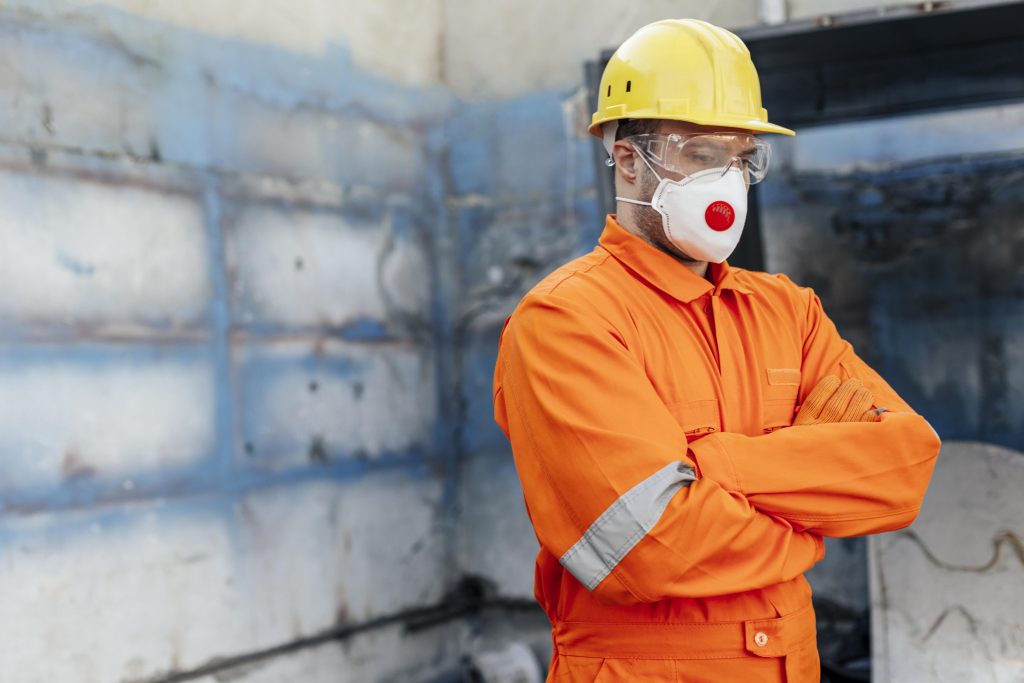
Industrial PPE Malaysia compliance is one of the most consistently misunderstood areas of occupational safety law in the country. According to the Department of Occupational Safety and Health (DOSH) Malaysia’s 2024 Annual Report, there were 44,765 reported workplace accidents in Malaysia in 2024 — 90% of which were preventable with correct PPE selection and usage. More concerning: DOSH’s enforcement data shows that PPE violations are the second most common offence cited in workplace inspections after inadequate hazard assessments. This guide identifies the seven most damaging industrial PPE mistakes made by Malaysian employers and site safety officers — and the exact corrective actions that prevent them.
Why Industrial PPE Compliance Matters More Than Ever in Malaysia
In 2024, Malaysia recorded 44,765 workplace accidents, 1,156 permanent disabilities, and 802 workplace fatalities — all requiring compensation under SOCSO and all representing a failure of the occupational safety system somewhere upstream of the incident. The financial cost of a single workplace fatality in Malaysia — combining SOCSO compensation, DOSH fines, legal costs, productivity loss, and reputational damage — averages RM 800,000 to RM 2.5 million per incident (NIOSH Malaysia, 2024).
DOSH’s enforcement direction in 2025–2026 has shifted toward higher-penalty prosecutions and increased unannounced inspections, particularly in construction, manufacturing, and oil and gas. Under the revised enforcement guidelines issued in 2025, DOSH inspectors now issue stop-work orders as a first response (rather than a warning) for life-safety PPE violations — meaning a single non-compliant PPE finding can halt production immediately.
The 7 Categories of Industrial PPE — Malaysian Standards Reference
| Category | Items | Malaysian/International Standard | DOSH Mandatory Use |
| Head Protection | Hard hats, bump caps | MS EN 397, MS EN 812 | Construction, electrical, heavy industry |
| Eye & Face | Safety glasses, goggles, face shields | MS EN 166, MS EN 170, MS EN 172 | Chemical handling, grinding, welding |
| Hearing | Ear plugs, ear muffs | MS EN 352-1, MS EN 352-2 | Areas above 85 dB(A) 8-hour exposure |
| Respiratory | Dust masks, half-face respirators, SCBAs | MS EN 140, MS EN 149, MS EN 136 | Chemical exposure, confined space, dust |
| Hand Protection | Cut, chemical, heat, electrical gloves | MS EN 388, MS EN 374, MS EN 407 | Specified by hazard assessment |
| Body Protection | Hi-vis vests, chemical suits, arc flash PPE | MS EN 471, MS EN 340, NFPA 70E | Traffic management, chemical plants, electrical |
| Foot Protection | Safety shoes, boots | MS EN ISO 20345, MS EN ISO 20346 | All industrial sites by default |
Mistake 1: Buying Non-Certified PPE to Save Cost
The single most dangerous industrial PPE mistake in Malaysia: purchasing uncertified PPE that looks identical to certified product but provides no reliable protection — and is not legally compliant under OSHA 1994. Uncertified PPE — including counterfeit 3M respirators (a documented problem in the Malaysian market), unbranded hard hats without MS EN 397 stamps, and safety shoes without ISO 20345 certification markings — is widely available at 30–60% below certified product prices.
The problem: a counterfeit N95 respirator may filter only 40% of particles (versus the 95% minimum required). A hard hat without proper EN 397 testing may shatter rather than absorb impact energy. A safety shoe without ISO 20345 steel toe cap certification may deform rather than resist a 200-joule impact.
What to do instead: Only purchase industrial PPE from authorised distributors who can provide CE/MS/SIRIM certification documentation for every product category. Bergamot is an authorised distributor for 3M, Honeywell, MSA, Ansell, and Delta Plus — all certified to Malaysian and international standards. Request the certification document (not just the sticker) with every order.
Mistake 2: Hazard Assessment Skipped — Wrong PPE Selected
Providing PPE without a hazard assessment is like prescribing medication without a diagnosis — the PPE may be completely wrong for the actual risk. The most common mismatch in Malaysian industrial sites: providing dust masks (FFP1) for workers exposed to chemical vapours (which require chemical cartridge respirators rated for the specific chemical); providing cut-resistance Level 1 gloves for workers handling glass or sheet metal (which requires Level 4 or 5 cut resistance).
Under Section 15 of OSHA 1994, employers are required to conduct a written hazard assessment for every work activity. The PPE specified must match the identified hazard. DOSH inspectors will request the written hazard assessment and verify that the PPE provided matches its conclusions — generic PPE not matched to a documented hazard is treated as non-compliant.
What to do instead: Conduct a written Job Safety Analysis (JSA) or Risk Assessment for every work activity and specify PPE by hazard type. Bergamot provides free PPE hazard assessment consultation for Malaysian industrial and construction clients — our safety specialists will visit your site and recommend the correct certified PPE for each task.
Mistake 3: No Fit Testing for Respiratory Protection
A respirator that does not fit correctly provides little or no protection — even if it is certified to EN 149 FFP3 standard. NIOSH Malaysia (2024) studies of Malaysian manufacturing workers wearing disposable respirators found that 62% were wearing the wrong size, resulting in face seal leakage that reduced protection by 40 to 80% from the rated level.
Malaysian employers providing half-face respirators or full-face respirators are legally required under OSHA Regulations to ensure fit testing for each wearer — either qualitative (taste/smell-based) or quantitative (electronic seal leakage measurement). Disposable FFP respirators require a user seal check before each use. Most Malaysian worksites skip both.
What to do instead: Implement a documented fit test programme for all tight-fitting respiratory PPE (half-face, full-face, and powered air-purifying respirators). Bergamot offers quantitative fit testing services using the TSI PortaCount Pro — the internationally recognised standard for respirator fit testing. Each worker is tested and issued a fit test record for the specific make/model/size of respirator they are authorised to use.
Mistake 4: PPE Replacement Based on Appearance, Not Standards
“It still looks fine” is the most dangerous PPE assessment method — and the most common one on Malaysian industrial sites. Three specific PPE items have defined service lives that are invisible to visual inspection:
· Hard hats — polycarbonate and HDPE shells degrade under UV (extreme in Malaysia) without any visible change in colour or structural appearance. UV-degraded shells fail at impact loads well below the EN 397 rated level. Replace every 3 years regardless of appearance, or every 1 year in high-UV outdoor environments.
· Fall arrest harnesses — webbing fades, but the load-bearing fibres degrade from UV, sweat (acids), and chemicals before any visual deterioration is visible. Inspect every 6 months per EN 365; replace at any sign of fibre fray, discolouration from chemical exposure, or after any arrested fall (a fall-loaded harness must be removed from service immediately regardless of appearance).
· Chemical gloves — permeation breakthrough (the point at which a chemical penetrates the glove material) is invisible — the glove appears intact while the chemical is already contacting the skin. Use EN 374 permeation-rated gloves appropriate for the specific chemical, observe the maximum service life per the manufacturer’s chemical resistance chart, and replace at the end of shift for high-hazard chemicals.
What to do instead: Implement a documented PPE replacement schedule based on manufacturer-specified service life and inspection intervals — not visual condition. Bergamot’s corporate supply programme includes a replacement scheduling service: we track service life by serial number and alert you when replacement is due.
Mistake 5: Inadequate PPE Training — Workers Don’t Use It Correctly
Providing PPE without documented training on correct donning, doffing, and use is both legally insufficient and operationally ineffective. OSHA 1994 Section 15 requires employers to provide not only PPE but also training in its use. DOSH inspectors ask workers directly: “How do you put on this respirator? How do you know it fits? When do you replace the filter?” Inability to answer these questions correctly constitutes a compliance failure even if the PPE itself is certified.
What to do instead: Conduct documented PPE training for every worker who uses PPE — covering correct donning and doffing sequence, visual inspection before use, care and storage requirements, and when to report or replace. Training records must be kept. Bergamot provides in-site PPE training workshops for Malaysian industrial clients covering all 7 PPE categories — training is delivered in Bahasa Malaysia or English and includes practical demonstration and worker competency check.
Mistake 6: Ignoring Heat Stress When Specifying PPE for Malaysia
Every layer of PPE adds thermal burden. In Malaysia’s climate — 30 to 35°C ambient with 80–90% humidity — chemical protective suits, arc flash suits, and high-visibility coveralls can create life-threatening heat stress within 30 minutes of continuous work. NIOSH Malaysia data shows that heat-related illness is one of the fastest-growing categories of occupational health claims in Malaysia — and PPE selection is a major contributing factor.
Specifying a chemical protective suit rated to EN 943 (Level A gas-tight suit) without a concurrent work-rest regime, hydration protocol, and heat stress monitoring programme is a compliance failure — the PPE protects against chemical exposure while creating a heat exposure risk that may be equally lethal.
What to do instead: When specifying PPE that adds significant thermal burden (chemical suits, arc flash, or SCBA), include a heat stress risk assessment in the hazard analysis. Implement work-rest cycles (typically 30 minutes work, 30 minutes in conditioned rest area for Level A chemical protection). Specify PPE with evaporative cooling inserts, vortex tube cooling, or phase-change cooling vests for extended-duration tasks. Bergamot stocks 3M and DuPont chemical suits with integrated cooling system compatibility.
Mistake 7: No PPE Inspection and Maintenance Programme
Reusable PPE — fall arrest harnesses, hard hats, reusable respirators, chemical gloves, and safety boots — require documented inspection and maintenance to maintain their rated protection level. A fall arrest harness that has not been inspected per EN 365 every 6 months is legally non-compliant regardless of its age or appearance. A reusable respirator with a damaged face seal valve (invisible without a proper inspection) provides zero face-piece seal.
What to do instead: Implement a written PPE inspection programme for all reusable PPE. Assign responsibility to a designated Competent Person. Document each inspection by serial number, inspection date, and inspector name. Tag inspected items with the next inspection due date. Quarantine any item that fails inspection — do not return to service until repaired or replaced. Bergamot supplies pre-printed PPE inspection registers and trained personnel to conduct periodic third-party inspections for Malaysian industrial sites.
Key Takeaways
· 44,765 workplace accidents were recorded in Malaysia in 2024 — 90% preventable with correct PPE. A single workplace fatality costs RM 800,000 to RM 2.5 million in total.
· DOSH now issues immediate stop-work orders (not warnings) for life-safety PPE violations on first inspection.
· The 7 critical mistakes: uncertified PPE, skipped hazard assessment, no fit testing for respirators, visual-only replacement decisions, inadequate training, ignoring heat stress, and no inspection programme.
· Hard hats must be replaced every 3 years (1 year outdoors) — UV degradation is invisible but real. Fall harnesses must be removed from service after any arrested fall.
· Every PPE category has a Malaysian or international standard (MS EN series, ISO series, NFPA) — verify certification documentation, not just product labels.
· Bergamot supplies certified industrial PPE across Malaysia (3M, Honeywell, MSA, Ansell, Delta Plus), offers site hazard assessments, respirator fit testing, and PPE training services.
Frequently Asked Questions — Industrial PPE Malaysia
What PPE is legally required in Malaysia?
Under OSHA 1994, Malaysian employers must provide PPE appropriate to all identified workplace hazards at no cost to workers. Specific requirements depend on the hazard: hard hats (MS EN 397) and safety shoes (MS EN ISO 20345) for construction and heavy industry; EN 149-rated respirators for dust and chemical environments; EN 361 full-body harnesses for work above 1.8m height. DOSH enforces compliance through unannounced inspections.
What are the 7 categories of PPE?
Head protection, eye and face protection, hearing protection, respiratory protection, hand protection, body protection, and foot protection. Each category has Malaysian (MS EN) and international (ISO, EN) standards defining the minimum certified protection level. Bergamot supplies certified products in all 7 categories from internationally recognised brands.
What is the DOSH fine for not providing PPE in Malaysia?
Under OSHA 1994, up to RM 50,000 per offence, 2 years imprisonment, or both — plus potential daily fines of RM 1,000 while the offence continues. DOSH now issues immediate stop-work orders for life-safety PPE violations on first inspection, making financial impact from production stoppage a larger cost than the fine itself.
How often should industrial PPE be replaced in Malaysia?
Hard hats: every 3 years (1 year for outdoor high-UV sites). Safety shoes: when sole tread reaches 3mm or at 12 months in heavy daily use. Respirator cartridges: per manufacturer service life specification (typically 8 hours active chemical exposure). Gloves: at any sign of damage or chemical permeation. Harnesses: after any arrested fall, or per EN 365 periodic inspection schedule (every 6 months maximum).
Does Bergamot supply industrial PPE across Malaysia?
Yes — Bergamot supplies certified industrial PPE throughout Peninsular Malaysia including Selangor, KL, Johor, Penang, Perak, and Pahang. We carry 3M, Honeywell, MSA, Ansell, and Delta Plus and offer site hazard assessments, fit testing, and PPE training. View our full industrial PPE range.