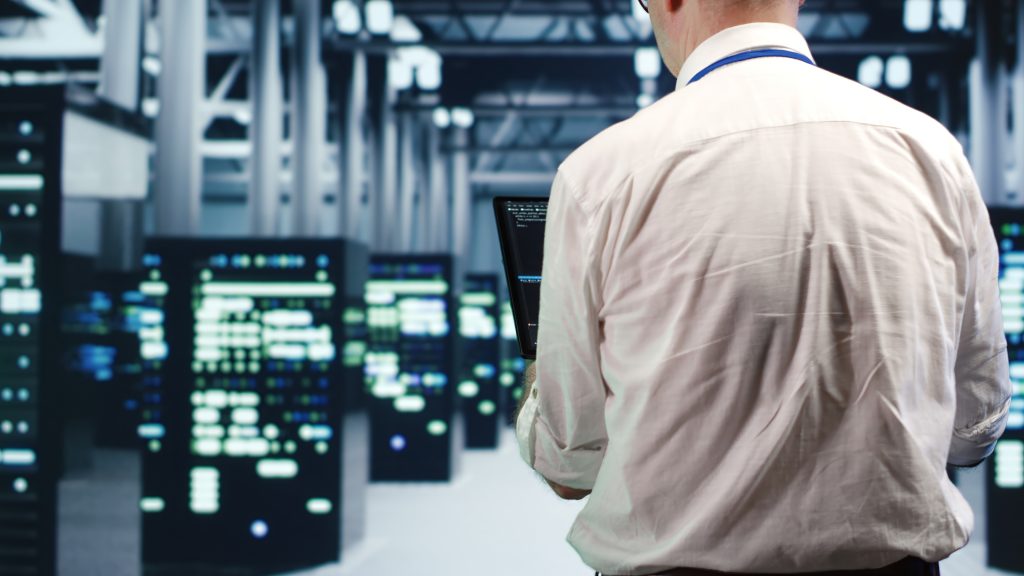
The Data Center Solutions as Critical Business Infrastructure
The data center solutions — whether a dedicated facility, a colocation suite, or a hyperscale cloud environment — is where an organisation’s most critical digital assets live. Servers, storage systems, networking equipment, and the data they process all require a controlled physical environment to operate reliably and securely. As Malaysian businesses generate and depend on ever-greater volumes of data, the data center infrastructure decisions they make have increasingly significant consequences for operational continuity, regulatory compliance, and competitive capability.
Understanding how data center work, what differentiates quality facilities from average ones, and how to match the right hosting model to your business requirements is essential knowledge for any technology decision-maker.
Data Center Tiers: What the Classification System Actually Means
The Uptime Institute’s Tier Classification System is the global standard for evaluating data center reliability. The four tiers represent increasing levels of redundancy and fault tolerance:
Tier I provides basic infrastructure with no redundant components. A single path for power and cooling, with expected annual downtime of up to 28.8 hours. Suitable for non-critical workloads only.
Tier II adds redundant capacity components — backup generators, UPS systems — but still operates on a single distribution path. Annual downtime approximately 22 hours.
Tier III introduces concurrent maintainability: multiple power and cooling distribution paths with one active at a time. Components can be maintained without shutting down IT systems. Annual downtime under 1.6 hours. This is the minimum standard for most enterprise production workloads.
Tier IV is fault-tolerant: all components are fully redundant and active simultaneously. A single failure anywhere in the facility causes no disruption. Annual downtime under 0.4 hours. Required for mission-critical applications where any unplanned downtime is unacceptable.
Colocation vs. On-Premise vs. Cloud: Choosing the Right Model
On-premise data center solutions give organisations full control over their infrastructure environment but require significant capital investment in facility construction or fit-out, ongoing operational costs (power, cooling, physical security), and specialist staff to manage the environment. For most organisations outside the largest enterprise segment, building and operating a dedicated data center is neither practical nor cost-effective.
Colocation (colo) provides rack space, power, cooling, and physical security within a professionally managed third-party facility. The organisation owns and manages its own servers and networking equipment but does not bear the cost of building and maintaining the facility itself. Colocation is the sweet spot for organisations that need the control of owned hardware but want to leverage a carrier-neutral, highly connected facility.
Cloud hosting delivers infrastructure as a service — compute, storage, and networking provisioned on demand from hyperscale providers. The operational simplicity and scalability of cloud hosting are compelling, but cost predictability at scale, data sovereignty requirements, and latency-sensitive workloads are factors that continue to drive demand for physical data center presence even among cloud-first organisations.
Power Infrastructure: The Heart of Data Center Reliability
Power is the single most critical resource in a data center. Enterprise-grade facilities operate dual power feeds from independent utility substations, backed by uninterruptible power supply (UPS) systems that provide instant protection against grid fluctuations and bridge power during generator startup. Diesel generators typically provide hours to days of backup runtime depending on fuel capacity.
Power Usage Effectiveness (PUE) is the standard efficiency metric for data centers — the ratio of total facility power to IT equipment power. A PUE of 1.0 would mean 100 percent efficiency (theoretically impossible); world-class hyperscale facilities achieve PUEs below 1.2. Legacy data centers often run at 1.8 to 2.0 or higher, meaning almost as much energy is consumed by cooling and infrastructure overhead as by the IT equipment itself. PUE is an important factor when evaluating colocation facilities — lower PUE means lower power costs and a smaller carbon footprint.
Cooling Systems and Thermal Management
Heat is the enemy of electronic reliability. Data center cooling systems maintain inlet air temperatures within the ASHRAE-recommended range (typically 18–27°C) while managing airflow to prevent hot spots. Traditional raised-floor computer room air conditioning (CRAC) systems are being supplemented and replaced by more efficient approaches: hot aisle/cold aisle containment, in-row cooling, rear-door heat exchangers, and in high-density deployments, direct liquid cooling.
Malaysia’s tropical climate creates specific challenges for data center cooling — ambient temperatures and humidity levels that are manageable but require careful design. Facilities in Malaysia that achieve strong PUE figures despite the climate demonstrate genuine engineering capability.
Connectivity: Why Carrier Neutrality Matters
A data center’s connectivity ecosystem is as important as its physical infrastructure. Carrier-neutral facilities — those that allow multiple telecommunications providers to bring their networks into the building — give tenants flexibility to choose and combine connectivity services based on performance, cost, and redundancy requirements. Facilities with direct interconnection to major internet exchanges provide lower-latency, higher-capacity connectivity for content and application workloads.
When evaluating a data center partner, review the list of carriers and cloud on-ramps available in the facility. A well-connected facility with direct access to major cloud providers’ private interconnection services significantly reduces the cost and complexity of hybrid cloud architectures.
Physical Security: Layers That Matter
Enterprise data center physical security operates in concentric layers: perimeter security (fencing, CCTV, security personnel), building access control (biometric readers, man-trap entry systems), cage and cabinet-level access controls, and continuous CCTV monitoring with recorded footage. For regulated industries — financial services, healthcare, government — the physical security credentials of a data center facility are subject to audit and must meet specific standards.
Selecting the Right Data Center Partner in Malaysia
For Malaysian organisations evaluating data center options, engaging with an established provider of data center solutions ensures access to facilities designed and operated to international standards, with the local expertise to navigate connectivity, compliance, and operational requirements specific to the Malaysian market.
Evaluate prospective partners on tier certification, power redundancy architecture, cooling design, carrier ecosystem, physical security credentials, and — critically — their track record of actual uptime rather than just theoretical design specifications.
Conclusion
The data center is where digital business risk is concentrated and where infrastructure investment delivers its most direct return. Whether you are evaluating colocation for the first time, rationalising a fragmented hosting estate, or planning for significant growth in data and compute requirements, a clear understanding of data center fundamentals — tiers, power, cooling, connectivity, and security — is the foundation for making decisions you will not regret.