The Modern Building Network: Why Convergence Is Now the Standard
Twenty years ago, a commercial building might have had a single network: an Ethernet LAN for computers and printers. Building Management Systems ran on proprietary protocols over serial communications, CCTV was analogue coaxial, access control was hardwired to dedicated controllers, and telephony ran on physical PSTN lines.
Each of these parallel, technology-specific infrastructure investments required separate installation, separate maintenance, and separate expertise. The total cost of this fragmented approach — in cabling, active equipment, energy, and management overhead — was enormous.
IP convergence has changed this fundamentally. BACnet/IP, Modbus TCP, and KNX over IP mean BMS runs on Ethernet. CCTV is IP camera-based. Access control is TCP/IP. Telephony is VoIP. Signage is IPTV. Every system in the modern building communicates over the same Ethernet/IP infrastructure — which means the physical cabling and switching infrastructure needs to be designed once, correctly, to carry all of them reliably and securely.
GPON vs Active Ethernet: Which Physical Infrastructure Is Right for Your Building?
Active Ethernet (Traditional)
Traditional Ethernet networks place active switching equipment at each distribution point — typically a telecommunications room on every second or third floor of a multi-storey building. Each switch requires power, cooling, maintenance, and management access. This infrastructure is well-understood and widely supported, but carries high capital cost for active equipment and ongoing energy and maintenance costs over the building’s life.
GPON Passive Optical Network
GPON replaces the active distribution switches with passive optical splitters — devices with no power requirement and no moving parts. A single Optical Line Terminal (OLT) in the main communications room drives gigabit connectivity to hundreds of endpoints via a passive fibre distribution network. No active equipment is required in distribution risers or floor distribution points.
- Energy savings: eliminating active equipment from distribution points typically reduces network infrastructure energy consumption by 60–80% in large buildings.
- Maintenance reduction: passive splitters have no failure modes — there are no network switches in distribution closets to fail, overheat, or require replacement.
- Future bandwidth: XPON upgrades (XGS-PON delivering 10 Gbps per port, NG-PON2 delivering 40–80 Gbps) are achieved by replacing only the OLT and ONUs — the fibre distribution infrastructure remains unchanged.
- Physical security: fibre is immune to electromagnetic interference and cannot be physically tapped without breaking the fibre — enhancing network security.
Structured Cabling: The Foundation of Network Infrastructure
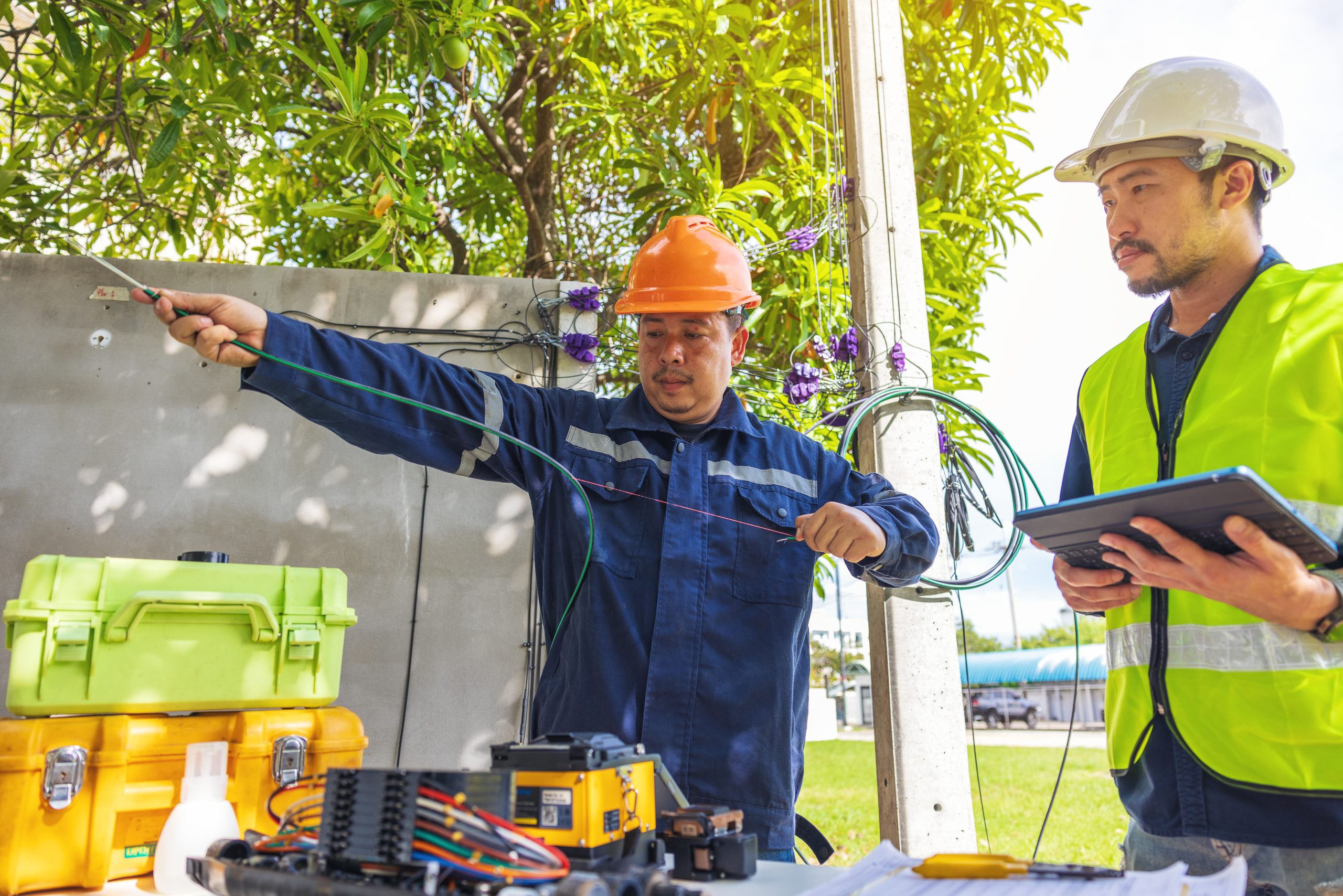
Structured cabling is the physical infrastructure that supports all network applications within a building. Unlike active equipment that can be upgraded over time, cabling systems are usually installed during construction or major renovations and are expected to last between 15 and 25 years.
Choosing the wrong cabling specification, using lower category cables, insufficient pathways, or non compliant installation methods can create long term limitations. In many cases, resolving these issues later requires costly and disruptive recabling work.
Copper cabling standards
- Category 6A: the current recommended standard for horizontal copper cabling in commercial buildings. Supports 10 Gigabit Ethernet to 100m and PoE++ (up to 90W per port) for powering high-demand devices including Wi-Fi 6/7 access points and Pan-tilt-zoom CCTV cameras.
- Category 7: enhanced shielding suitable for environments with high electromagnetic interference, including manufacturing facilities and hospital environments adjacent to MRI equipment.
Fibre cabling standards
- OM3/OM4 multimode fibre: cost-effective for backbone runs up to 300m (OM3) or 400m (OM4) at 10 Gigabit speeds. Preferred for inter-floor and intra-building backbone runs in most commercial buildings.
- OS2 single-mode fibre: used for long-distance runs between buildings in campus networks, supporting 10 Gigabit to 10km and 40–100 Gigabit over shorter distances.
LHSE supplies Belden structured cabling solutions with full test and certification documentation — providing performance guarantees and warranty coverage that protect the building owner’s infrastructure investment.
BMS Network Connectivity: Supporting Building Automation
Building Management Systems (BMS) handle important operational data such as temperature, humidity, and CO2 readings for HVAC control, equipment status from chillers and lifts, energy monitoring data, and alarm signals for emergency response systems. This data requires a stable network infrastructure with reliable delivery, low latency, and proper separation from general IT traffic to avoid network congestion.
LHS designs BMS network infrastructure using dedicated VLAN segmentation, which separates BMS traffic from other systems such as IT networks, CCTV, and AV systems while still using the same physical infrastructure. This approach improves network reliability and performance without the added cost of building completely separate networks.
Green Mark and BCA Compliance for Building Networks
Singapore’s BCA Green Mark certification scheme and Smart FM initiative require building networks that support energy monitoring, space usage tracking, environmental monitoring, and integration with intelligent building management systems.
LHSE designs building network solutions with these requirements in mind, providing the connectivity infrastructure needed to support smart building operations and meet modern Green Mark compliance standards.
Final Word
The building network is the nervous system of a modern commercial property — it determines how well every automated system, security system, and occupant service performs for the life of the building. Investing in the right architecture from the start — GPON passive optical where appropriate, correctly specified structured cabling, properly segmented BMS connectivity — delivers lower lifetime costs and greater resilience than any amount of reactive remediation of under-specified infrastructure.